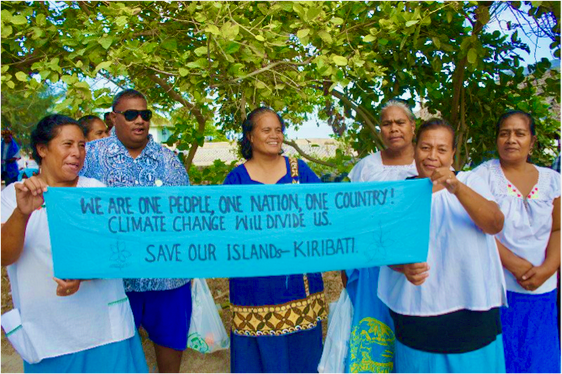
Teitiota v. New Zealand.
Introduction
According to the UN Refugee Agency (UNHCR), over 120 million people are currently forcibly displaced worldwide, with three-quarters residing in countries severely affected by climate change. In 2022 alone, weather-related hazards led to nearly 32 million displacements, an increase of 41% compared to 2008. Despite this growing crisis, there remains no universally recognized definition of “climate refugees,” nor does the 1951 Refugee Convention extend protection to those displaced by environmental factors. Article 1 of the Convention defines a refugee as an individual who, due to a well-founded fear of persecution based on race, religion, nationality, membership in a particular social group, or political opinion, is unable or unwilling to seek protection from their country of origin. As a result, individuals forced to flee due to climate change lack legal recognition and protection under existing international refugee law.
However, courts have the capacity to develop jurisprudence that extends legal protection to those displaced by climate change. Climate litigation can serve as a powerful mechanism to push for their legal recognition and protection, challenging the existing gaps in international frameworks. To this end, governments must be held accountable under human rights law, compelling them to adopt legal measures that safeguard “climate refugees” and efficiently protect their fundamental rights.
This could be done through firstly, expanding the interpretation of “persecution” in refugee law in order to include this group of people forced to migrate due to climate change. Meaning that, environmental disasters could be understood as a way of “indirect” persecution when resulting from government's inaction or even corporate negligence. As one of the most significant case law examples we find the 2020 Teitiota v. New Zealand case where it was ruled that deporting climate displaced individuals to life-threatening conditions could be seen as a violation of the non-refoulement principle. This principle refers to the binding international customary law prohibition of sending individuals back to a State where they face a real risk of being subjected to persecution, torture, inhuman or degrading treatment or any other human rights violation.
This landmark case has been revolutionary as the Human Rights Committee (HRC), a UN human rights body, ruled for the first time that governments must take into account the human rights violations that can emanate as a result of climate change in deportation cases of refugees.
Facts of the case
On 15 September 2015, the applicant submitted an initial claim to the Human Rights Committee (HRC), appealing a prior decision by the New Zealand domestic courts about his deportation to the Republic of Kiribati. He argued that said deportation violated his right to life under Article 6 of the International Covenant on Civil and Political Rights (ICCPR). The applicant, Ioane Teitiota was a national of Kiribati; an island nation found in the central Pacific Ocean in Micronesia.6 Everything resulted from his attempt to claim refugee status on the grounds of climate change-induced threats. The Committee examined both procedural issues, including the admissibility of the claim (assessing whether the claim was manifestly ill-founded and whether Teitiota had victim status due to the State’s alleged failure to take positive measures to protect his right to life), and the substantive issue: whether New Zealand, as the defendant State party, had violated its obligations under the ICCPR and its Optional Protocol by denying Teitiota refugee status and proceeding with his deportation to Kiribati.
The claimant justified his forced migration through climate change related factors including the inability to grow crops, a lack of potable water, rising sea levels, and increasing violence due to land disputes linked to the housing crisis. The first legal body to assess his case was the Immigration and Protection Tribunal. In its 2013 decision, after considering multiple sources, it concluded that no violation of neither Article 6 nor 7 of the ICCPR had occurred. The tribunal started by examining: 1. The 2007 National Adaptation Program of Action filed by Kiribati, which acknowledged the severe effects of climate change on the territory. 2. The expert testimony of John Corcoran, who described the crisis caused by infertile soil, high unemployment, violent disputes, worsening storms, lack of clean water, and health hazards from waste disposal on beaches. 3. The applicant’s own testimony, in which he explained that he and his wife were forced to leave Tarawa to secure a better future for their unborn children, as there was "no future possible in the country." 4. The oral testimony of his wife reinforced these concerns, emphasizing that crops were dying, children were getting sick, and land was becoming dangerously overcrowded. She also argued that internal relocation to another island was not a viable option. Despite these considerations, the Tribunal ruled against the applicant, determining that his deportation did not constitute a violation of Article 6 ICCPR (right to life).
Furthermore, the Tribunal also considered whether Teitiota could be qualified as a "refugee" under the 1951 Refugee Convention, assessing both sudden and slow-onset climate-related impacts on Kiribati. While it acknowledged the challenges faced by the author and his family, it concluded that he did not face a real risk of persecution upon his return and thus did not fall within the definition of a refugee under Article 1 of the Convention.
The reasons why were the following: 1. Teitiota had never been involved in land disputes, nor was there evidence suggesting he would face persecution in the future. 2. Accommodation remained available for him and his family. 3. Potable water was still accessible as there was not enough evidence proving otherwise. 4. The environmental conditions, though difficult, did not pose an immediate or extreme threat to his life that would justify refugee status
Subsequently, the Tribunal examined whether there had been an arbitrary deprivation of life by checking three possible interferences: (a) not prescribed by law; (b) not proportional to the ends aimed; and, (c) not necessary in the particular circumstances of the case. While it was deemed that States have a positive obligation to protect the right to life, the Tribunal ruled that Teitiota failed to provide sufficient evidence to prove any failure by New Zealand in this regard. Similarly, he was unable to establish that there was a sufficient degree of risk to his life or family. The risk, the Tribunal emphasised, had to be “imminent” and in this case it was based on presumptions; meaning that there were no substantial reasons for believing that the author, nor any of his family members, would be in danger of a violation to enjoy their right to life at the relevant time. Therefore, it was decided that there had not been a violation of Article 6 of the Covenant.
Additionally, the Tribunal found no violation of Article 7 ICCPR, which prohibits torture, cruel, inhuman, or degrading treatment or punishment.
Following this decision, Teitiota appealed to the Supreme Court, but his appeal was denied. The Court ruled that he was not facing serious harm and that the Government of Kiribati was fulfilling its duty to protect its citizens. However, the Court made an important observation: while Teitiota’s case did not meet the current legal threshold, environmental degradation caused by climate change could, in the future, influence the interpretation of the Refugee Convention or other protected person jurisdictions to expand their scope.
Legal issues
Main Complaint and Observations of the Parties Teitiota’s deportation to Kiribati constituted the main complaint, as he argued that New Zealand violated his right to life by sending him to a territory severely impacted by rising sea levels. He claimed that climate change had made habitable land scarce, leading to violent land disputes and saltwater contamination of drinking water due to environmental degradation.
New Zealand began its observations on admissibility by noting that Teitiota and his wife had three children in New Zealand after their arrival on its territory. However, none of them acquired citizenship, and the family remained in the country beyond the expiration of their residence permits in 2010.
In May 2012, Teitiota initiated legal proceedings to obtain refugee or protected person status. However, three months later, the claim was refused by the Refugee and Protection Office as it reasoned that under the Immigration Act 2009 he did not fall under the scope of either of the previously mentioned categories. Teitiota appealed this decision to the Immigration and Protection Tribunal, but his claim was again denied. Subsequent appeals to the High Court and Court of Appeal were also unsuccessful.
Furthermore, the State Party presented three main reasons as to why it believed the claim to be inadmissible:
1. Lack of evidence of imminent harm, Teitiota failed to prove that he would suffer an imminent threat to his life upon return. 2. Contradictory evidence, as his evidence did not demonstrate a real risk of arbitrary deprivation of life: not through violence, nor inability to grow crops, or alleged failure of Kiribati´s Government to uphold its positive obligations to protect the lives of its citizens. 3. Insufficient substantiation, there was no new evidence and domestic courts already assessed that there had not been a violation of Article 6 of the Covenant. The author maintained that he and his family were facing several health issues in the island and were unable to grow crops, leaving them without income or means of survival. Additionally, he argued that more evidence was indeed submitted which, he argued, supported his claim that Kiribati would soon face serious survival threats due to the climate crisis.
Regarding the merits, the State party argued that there was no proof that Teitiota was suffering, or would suffer, actual or imminent harm. It also questioned Teitiota’s victim status (which he lacked) and argued that his non-refoulement claim was unsubstantiated. In response, Teitiota replied that he was facing an intermediate risk of serious harm in Kiribati. The applicant claimed that the country was losing land mass and had only 10 to 15 more years of habitability. Moreover, he argued that he and his family were already suffering the effects of climate change and that the evidence provided was sufficient to show it, but authorities had ignored it.
Issues and Proceedings before the HRC:
The Committee began by declaring the communication admissible. It assessed the applicant's alleged victim status regarding his deportation to Kiribati and deemed that he faced a real risk of impairment to his right to life under Article 6 of the Covenant due to the lack of potable water, employment possibilities, and the threat of possible serious violence by land disputes.
As of the merits, the HRC emphasised that the scope of Article 6 ICCPR may be broader than the “non-refoulement” principle under international refugee law as it also requires the protection of those who do not qualify as refugees. This interpretation could benefit victims of climate-induced displacement, such as Teitiota and his family, who are not yet covered under the Refugee Convention. Therefore, the HRC establishes that State parties must provide all asylum seekers alleging a risk to their right to life with all the available protections against refoulement. Furthermore, the Committee made an important statement regarding the impact of climate change on human rights, declaring that:
"Environmental degradation, climate change, and unsustainable development are serious threats that could prevent future generations from fully enjoying the right to life."
When assessing whether the State party's evaluation of Teitiota’s claim contained arbitrariness, error, or injustice, the Committee ultimately concluded that there was no evidence of an imminent risk of arbitrary deprivation of life upon his return to Kiribati. Additionally, it considered that New Zealand’s authorities had provided an individualized assessment of his need for protection by considering all the reasons presented by the applicant:
1. Violent land disputes due to scarcity of land: The Committee found that the incidents described were too general and sporadic, with no clear evidence that state intervention would be insufficient to address them. 2. Lack of access to potable water: There was not enough evidence to prove that potable water is insufficient. 3. Crops destroyed due to salt deposits, leading to loss of income: It was concluded that there was no reasonably foreseeable risk of exposure to deprivation of food, as alternative opportunities of employment were available. 4. Overpopulation and the risk of intense floorings and breaches of sea walls: Given the estimated 10 to 15 years before Kiribati might become uninhabitable, the Committee determined that the government still had time to implement positive measures to safeguard the population.
Decision of the Court
Even though the Human Rights Committee did state that the States must consider the worsening effects of climate change when assessing future deportation cases, it ultimately ruled that New Zealand did not violate Article 6 of the ICCPR in relation to Teitiota’s removal to Kiribati.
The interpretation of the principle of “non-refoulement”
“No one should be returned to a State where they would face torture, cruel, inhuman or degrading treatment or punishment and other irreparable harm”
This principle is applicable to every person subject to a State's jurisdiction, including all migrants (regardless of ability to gain or maintain status as a refugee), irrespective of their status and regardless of whether the person has entered the State regularly or not. Even the HRC stated that the enjoyment of the rights under the ICCPR is applicable to “all individuals, regardless of nationality or stateliness, such as asylum seekers, refugees, migrant workers and other persons, who may find themselves in the territory or subject to the jurisdiction of the State Party”.
The non refoulement principle has been codified in different legal instruments, such as:
1. Articles 6 & 7, ICCPR: Protecting individuals against deportation that would otherwise led to a violation of their fundamental right to life or exposure to torture, cruel, inhuman or degrading treatment. 2. Article 33, 1951 Refugee Convention: Prohibition of sending refugees to territories in which their lives or freedoms would be threatened due to their race, religion, nationality, membership in a particular social group, or political views. 3. Article 3, Convention Against Torture: Prohibition of sending a person to a State in which they would face torture. The inclusion of this principle in international instruments, ratified by a large number of States, has led to its acceptance as a norm of customary law. Therefore, this obligation is binding to all States in the international community; and is even considered to be a jus cogens norm, as no derogation is permitted.
Although it has traditionally only been applied to persecution cases, the Teitiota v. New Zealand case signified a major breakthrough, as it was recognised that climate change could, in the not-so-distant future, trigger non-refoulement obligations, despite the Committee not finding a violation in this specific case.
Dissenting Opinions
This case counts with two individual dissenting opinions from Committee members, as they disagreed with the majority ruled opinion.
Both committee members agreed that the author's removal from New Zealand back to Kiribati constituted a violation of his right to life under Article 6 of the ICCPR, but they focused on different aspects.
Firstly, Vasilika Sancin argued that the State Party failed to conduct a proper assessment of the applicants and his family's access to safe drinking water in Kiribati. She emphasised that this issue was central to the violation of Article 6 of the Covenant, as the inaccessibility of safe drinking water constituted an imminent threat to their lives. Sancin distinguished between “potable water” and “safe drinking water” noting that the latter is essential for maintaining health. Moreover, she disagreed with the Committee and Tribunal's opinions regarding the lack of evidence presented by Teitiota to demonstrate that the supply of fresh water was inaccessible, insufficient, or unsafe to the extent that it could threaten his and his family´s right to life or cause premature death. Sancin pointed to an expert report by the UN Special Rapporteur on the human right to safe drinking water and sanitation, which warned that Kiribati had not yet implemented the newest policies about national water resources and sanitation. Therefore, she argued that the inability of Teitiota and his family to access safe or even potable drinking water in Kiribati represented an imminent risk to their right to life under Article 6 of the Covenant.
Secondly, Duncan Laki Muhumuza called for a more human-centered approach by the Committee to human rights issues, criticising the unreasonable burden of proof imposed on Teitiota. He emphasised that the evidence the applicant presented was undisputed and disregarded by both the State Party and the Committee. Muhumuza highlighted the imminent risks to Teitiota´s right to life including violent land disputes over scarce habitable space,inadequate and poor-quality water supply, destruction of food crops, the inability to sustain himself and family, recurring flooding and the health issues already affecting his children. Muhumuza made a very interesting assessment of the right to life, clarifying that it includes not only the right to survival but also the right to live with dignity, free from acts or omissions likely to cause unnatural or premature death. He concluded that Teitiota faced a reasonable, real, personal and foreseeable threat to his life due to the worsening environmental conditions in Kiribati.
Moreover, he argued that the difficulty of accessing safe drinking water and growing crops was a significant enough risk to suppose a threat to his right. Importantly, he emphasized that measuring threats to life solely by counting deaths resulting from such conditions is counterintuitive; violations of the right to life can exist even without immediate fatalities. Lastly, he argued that the standards of dignity required by the ICCPR must be met when dealing with cases presenting similar environmental degradation effects as the ones presented in Kiribati. The fact that the entire population is facing these conditions does not justify nor dignify their suffering. Therefore, he concluded that both life and dignity of individuals in Kiribati remain at severe risk due to the country’s worsening environmental crisis.
Commentary
Teitiota v. New Zealand is a landmark case in the evolving jurisprudence on ‘climate refugees’. On one hand, it represented a significant step forward in recognizing the potential for climate change to trigger non-refoulement obligations. On the other hand, for the applicant, it failed to provide the protections he clearly needed. The decision by the Human Rights Committee not only sparked dissenting opinions among its own members but also opened up an important and urgent debate. Regardless of whether one agrees with the ruling, its impact on legal and policy discussions is undeniable. Even the current UN High Commissioner for Refugees, Filippo Grandi, shared his view on it:
“The ruling says if you have an immediate threat to your life due to climate change, due to the climate emergency, and if you cross the border and go to another country, you should not be sent back because you would be at risk of your life, just like in a war or in a situation of persecution”
Despite the recognition of climate change as a potential driver of forced displacement, international protection frameworks still lack explicit legal protections for those affected. Five years have passed since Teitiota v. New Zealand, and several institutions have taken a stance on the matter.
The African Commission on Human and Peoples Rights has actually broadened its regional refugee definition to include individuals forced to migrate due to climate-related events or disasters, regardless of whether these disturbances seriously disrupt public order. In the Americas legal interpretations have acknowledged that if climate change leads to serious public disorder and a country is unable to provide effective protection, affected individuals may qualify for refugee status; even if not meeting neither of the grounds under Article 1 of the 1951 Refugee Convention.
The European Court of Human Rights has yet to rule on a case where individuals seek international protection due to climate change-induced risks of inhuman or degrading treatment. Through its case law, the Court has expressed that “regional courts should address the impacts of environmental harms on the enjoyment of human rights”.
Although the 1951 Refugee Convention does not explicitly recognize ‘climate refugees,’ states are gradually developing regional protections to address this growing challenge. However, the question remains whether these efforts will be enough to effectively protect this vulnerable group of refugees.
One thing is for sure: climate change will only worsen over time. Each passing year is declared the ‘warmest on record,’ yet legal gaps remain unaddressed. If we fail to act now, millions will face forced displacement due to worsening environmental conditions, along with the risk of mistreatment in host States.
Merely drafting and ratifying new conventions, at both international and national levels, is not enough. Legal solutions in this area are difficult to predict (flooding, droughts…) we must firstly assess the challenges and different realities faced by climate migrants in their home States. Only then can we develop adaptable legal frameworks with broad applications that respond effectively to the evolving and uncertain nature of climate change.
Climate change will inevitably affect everyone. It is easy to look the other way when its consequences do not seem to impact us directly, but ignoring the problem does not make it disappear. Instead of passively witnessing these unfolding crises, we must listen to one another and act in solidarity.
As the ending note for this commentary, I chose to include Teitiota’s response to the Human Rights Committee following its decision on his case. This is because it highlights the sense of impotence felt by thousands of people in similar situations who are simply seeking help:
‘Forgive my ignorance, but to be frank, I’m quite disappointed with the outcome of my case which has been recently released from the UN… It’s still the same as before — I’m still worried about my family [because of] climate change … the sea level rise, the drinking water is not good… [and] I’m still yet to find a job until now. Personally, I think big countries like NZ should accept us and not ignore our plight because our islands are very low-lying and we are vulnerable even to the slightest bad weather or storm surge. I want to ask these big countries to please take our case seriously because we need their help… The notable difference is that my children are more vulnerable here to the spread of diseases such as a virus infection like a flu or diarrhoea’
Takeaways
1. Recognition of climate change as a human rights issue. 2. Widened application of the non-refoulement principle. 3. Need to address legal gaps within the current legal frameworks. 4. Positive obligations of States to intervene when addressing migration as a result of degrading climate change effects. 5. Teitiota v New Zealand as a landmark case in climate forced migration.
Bibliography
Primary Sources:
1. Convention Relating to the Status of Refugees (adopted 28 July 1951, entered into force 22 April 1954) 189 UNTS 137.
2. International Covenant on Civil and Political Rights (adopted 19 December 1966, entered into force 23 March 1976) 999 UNTS 171.
3. Convention Against Torture (opened for signature 10 December 1984, entered into force 26 June 1987) 1465 UNTS.
4. Teitiota v New Zealand (UN Human Rights Committee, 7 January 2020) Communication No 2728/2016, UN Doc CCPR/C/127/D/2728/2016.
5. Grand Chamber, Case of Verein Klimaseniorinnen Schweiz and Others v. Switzerland (Application no. 53600/20) (European Court of Human Rights, 9 April 2024) https://hudoc.echr.coe.int/eng?i=001-233206 accessed 9 March 2025.
Secondary Sources:
1. Amnesty International, ‘UN Landmark Case for People Displaced by Climate Change’ (20 January 2020) https://www.amnesty.org/en/latest/news/2020/01/un-landmark-case-for-people-displacedby-climate-change/ accessed 6 March 2025.
2. Behrman, Simon and Kent, Avidan, ‘The Teitiota Case and the Limitations of the Human Rights Framework’ (2020) QIL - Questions of International Law https://www.qil-qdi.org the-teitiota-case-and-the-limitations-of-the-human-rights-framew ork/#_ftnref2 accessed 9 March 2025.
3. Baker, Luke, ‘World Needs to Prepare for Millions of Climate Refugees: UN’ (Financial Post, 21 January 2020) https://financialpost.com/pmn/business-pmn/world-needs-to-prepare-for-millions-of-clim ate-refugees-un accessed 9 March 2025.
4. Encyclopædia Britannica, ‘Kiribati’ https://www.britannica.com/place/Kiribati accessed 6 March 2025.
5. Gilbert, Geoff and Wood, Tamara, ‘International Protection for People Displaced Across Borders in the Context of Climate Change and Disasters: A Practical Toolkit’ (EJIL: Talk!, 4 March 2025) https://www.ejiltalk.org/international-protection-for-people-displaced-across-borders-in-the-context-of-climate-change-and-disasters-a-practical-toolkitaccessed 9 March 2025.
6. International Organization for Migration, Updated IML Information Note on Non-Refoulement (2023) https://www.iom.int/sites/g/files/tmzbdl2616/files/our_work/ICP/IML/2023-updated-imlinformation-note-on-non refoulement.pdf accessed 9 March 2025.
7. UNHCR, ‘UNHCR Report Reveals Climate Change a Growing Threat for People Already Fleeing War’ (7 November 2024)https://www.unhcr.org/news/press-releasesunhcr-report-reveals-climate-change-growingthreat-people-already-fleeing-war accessed 20 February 2025.
8. UNHCR, ‘Climate Change and Displacement: Myths and Facts’ (18 December 2023) https://www.unhcr.org/news/stories climate-change-and-displacement-myths-and-facts accessed 20 February 2025.
9. Wasuka, Evan, ‘Landmark Decision from UN Human Rights Committee Paves Way for Climate Refugees’ ABC News (21 January 2020) https://www.abc.net.au/news/2020-01-21/un-human-rights-ruling-worlds-first-climate-refugeekiribati/11887070 accessed 9 March 2025.
10. European Commission, ‘Non-Refoulement’ (European Migration Network, 2023) https://home-affairs.ec.europa.eu/networks european-migration-network-emn/emn-asylum-and-migration-glossary/glossary/non-refoulement_en accessed 9 March 2025.
11. Intergovernmental Panel on Climate Change, Fifth Assessment Report (2014) https://www.ipcc.ch/report/ar5/ accessed 6 March 2025.